
Shared-tech
Second-hand appliances sharing platform
Year
2021
Category
Service design/ Design research
Team
Maryem Abbas
Rosa Chu (team leader)
Yoshi Perera
In an age where consumers are increasingly conscious of their purchasing decisions, the focus has shifted from consumerism to environmental impact, social responsibility, and long-term sustainability. Yet, for many people, what sustainability is, why it matters, and how to do it are the most common questions on people's minds. This is how we started our idea for Smart Cities Datathon 2021 by Asian Development Bank. Our idea was to develop a second-hand appliances sharing platform to reduce the E-waste issue in South Asia. This project was enrolled into the Top 4 finalists. Let's have a closer look...


Have you ever bought appliances but only used them once or twice? And now they're sitting in a dusty corner of your room, waiting for their chance to be used again?
5 min overview
1. Issues
Low recycling rates and uneven distribution of resources cause the E-waste problem in Southeast Asian areas. Further, E-waste results in potential hazards to the human body and environment. Therefore, our team came up with this question:
"How can we leverage Smart Cities' infrastructure to reduce inequalities and promote sustainable use of electronic appliances in Southeast Asia? "
3. Solution
Unlike existing platforms where users could only sell products, Shared-tech is a renting platform. We found that the majority population in Southeast Asia is still in the middle or low-income station. They had very low purchasing power and access to digital products. Compared to buying a full product, renting them is a more affordable way. We encouraged our users to share their resources with communities with a bit of compensation.
We targeted university students as our pilot user population. Not only are they more likely to be under financial stress, but also strong early adopters of new technologies and services.
2. Opportunities
Secondary data suggested that sharing was a common cultural practice in Southeast Asia. The current market also showed that the top-selling category was electronic products. So, a new type of second-hand platform could facilitate the sustainable use of electronic appliances.
Showing as below
5. Reflection
Personally, I think our idea hit the spot. Although Shared-teach is a Non-profit project, we still need a certain amount of money to run this business. The next step is to find sponsors and promote the potential benefits to them. For example, some Kickstarter projects might need pilot users for their beta version. Shared tech would be a good place.
Full research
Problem Framing
Background and problem statement
The latest Global E-waste* Monitor report, in 2020, the recycling rate of e-waste was less than 1% in the Southeast and South Asia regions and the most of these waters were appliances. Those E-wastes that were not recycled can potentially lead to environmental contamination, which can impact individual's health (Forti et al., 2020). Additionally, the report from IMF (International Monetary Fund), countries in Southeast Asia are still primarily in the middle- or low-income range (IMF, 2021). These middle- and low-income countries have a very low purchasing power and access to digital products, including laptops, tablets, and mobile phones(Forti et al., 2020). Therefore, we proposed our problem statement:
How can we leverage Smart Cities' infrastructure to reduce inequalities and promote sustainable use of electronic appliances in Southeast Asia?
Opportunity
To answer this statement, we targeted the second-hand market in Southeast and South Asia regions. Studies within Southeast Asia revealed that individuals had had experiences of sharing their electronic products with others. Indicating that sharing was a common cultural practice in those areas (Kuah & Wang, 2020). Carousell, the biggest second-hand market platform in Southeast Asia, showcased that the top-selling category was currently electronic products (Carousell, 2021). Thus, we believed that the second-hand market could facilitate the sustainable use of electronic appliances.

Iceberg digram for dissecting what was the real issue behind the surface problem-increase of E-waste
Solution Framing
What is Shared Tech
Let us introduce our solution-ShareTech
SharedTech is a resource-sharing platform that allows users in a community to share their rarely-used but functional appliances with others. Users can post appliances for others to use, rent appliances others have posted, as well as request appliances that are not available in the catalogue. SharedTech promotes sustainability by extending the lifespan of electronic products and seeks to reduce inequalities by providing users with access to appliances while also helping users earn extra pocket money for day-to-day use.
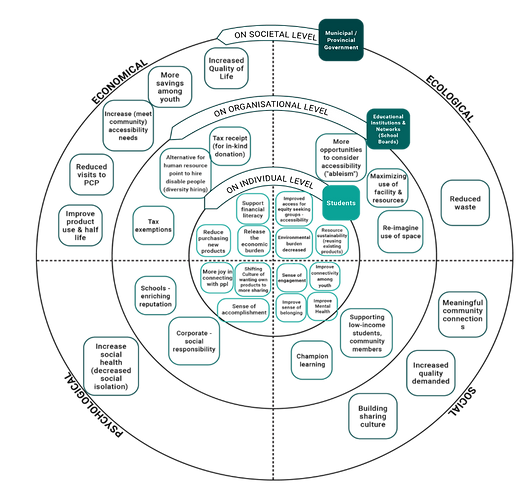
Value Proposition of ShareTech
Value Proposition
We analyzed our solution through 4 different apsects: economical, ecological, psychological, and social within value of 3 levels, individual, organization, and societal to understand how ShareTech positioned its value in the system.
We believed that SharedTech promoted a sharing culture that strengthens individual financial literacy, increases access to technology, and reduces electronic waste. Students and young adults might have various reasons to avoid purchasing new appliances, including financial strain, environmental stances, minimalist lifestyles, lack of storage space, commitment, and duration of stay within the region. This platform could alleviate the burdens purchasing electronics may cause.
Framework
There were three primary stakeholders in our service
-
SharedDonors: Users who will be putting their appliances on the platform to share in exchange for some incentive.
-
SharedUsers: Users who will be borrowing the appliances through a small transaction
-
SharedQuality: Will ensure the quality of the product is usable to be shared and returned.
In our pilot stage, Sharetech only offered pick-up (both storage facilities and lenders' location) and on-site usage. In the scale-up version, Sharetech would introduce the third-party service into our system, such as delivery or drop-off box.

Framework
Target Audience
Who are they
With pilot intervention, our team selected the students, domestic, international and foreign exchange. as demographic. It was because this demographic represented a group of potential and untapped users. We found that these youth were:
-
Likely to own and use a mobile device while being a strong early adopter of new technologies and services.
-
More likely to be under financial stress and benefit from a service like SharedTech to allow them to access the appliances that they need.
-
International and foreign exchange students may not have easy access to technology and appliances if their own devices become dysfunctional.
50%
of internet users aged 16 - 64 who own a laptop or desktop computer
94%
of internet users aged 16 - 64 who own a mobile phone
(Kemp, 2020)
-
Segment: Students in college and/or university; Age 18 - 25
This demographic would be used for the pilot, with the potential to expand to other age groups and community members later on.
-
Relationship: Catalogue of appliances would be available on website and app anytime. Access to and use of appliances within designated school facilities and school hours.
-
Channels: Users and donors will be reached through word-of-mouth, print flyers & promotional events at school. Postings on social media platforms to promote service.
Persona
Meet Achara Saetang
Age: 19
Occupation: a first-year student at Chulalongkorn University.
It was her first time living alone and moving out of her hometown city, so she did not bring much luggage but essence.
Here is her story...
While she moved into accommodation at university, she realized she did not have many appliances, like a vacuum cleaner, kettle, or iron. However, one day she got a part-time job interview. She needed to wear a formal dress code, but her shits were wrinkled. She had no time to buy a new iron. Achara heard about SharedTech from her peers and decided to check out the platform. Once signing up for SharedTech, she would have access to a variety of small appliances that she might need with a few simple clicks, which she can rent based on her day-to-day needs. She was able to conveniently pick up items that she knew had been screened for quality without the hassle of messaging and setting a time to pick up the product from storage facilities in the campus for the psychological safety concerns of meeting strangers online.
User Journey

Result
There were some expemple of wireframe of Sharetech.
Flow #01 Registration
The prototype gives an overview of the simple registration process for the pilot program. The simple and clean layout ensures easy access and management of the services provided for users. It also would provide stock and record management tools for the organization.

Flow #02 Renting & Lending
The flow gives an overview how SharedUsers & SharedDonars will interact with the app. Following a simple few click process will ensure fast and easy access to appliances needed.

Flow #03 Payment & Credit Score
The prototype gives an overview of the simple process to add payment that goes towards your credit. Credit is used towards deposit fees for damaged/lost products and payment to rent products. For SharedDonars, money can go towards credits or can be transferred to you bank account directly.

Flow #04 Your Environmental Contribution
The prototype gives an overview of the incentive to use SharedTech and see directly how you are postively impacting the environment. The plant grows as you utilize the service more and you are able to compare results with friends and family.

